
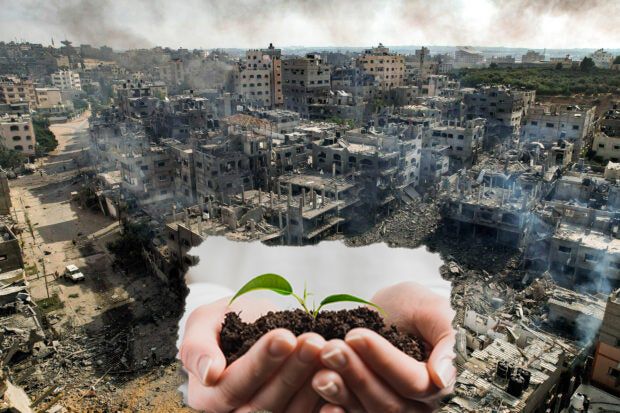
Soil Pollution Treatment and Its Role in Post-War Reconstruction
After the end of the war in Syria and the resulting destruction and humanitarian and environmental impacts, the need for reconstruction emerged with the aim of reviving destroyed cities, restoring infrastructure, and achieving long-term stability.
 by Dr. Rania Khaled Zartit5 min read
After the end of the war in Syria and the resulting destruction and humanitarian and environmental impacts, the need for reconstruction emerged with the aim of reviving destroyed cities, restoring infrastructure, and achieving long-term stability.
The term "reconstruction" is not limited to urban rebuilding alone; it extends to encompass environmental, health, economic, and social dimensions as interconnected elements in the comprehensive post-war recovery process.
This process is complex after years of war and destruction, requiring careful planning given the contamination caused by weapons and explosives, along with its long-term environmental consequences. This phase also draws on previous studies and research, as well as the experiences of countries that have undergone similar wars, in order to develop effective strategies grounded in the principles of sustainability and the protection of the environment and vital sectors such as agriculture and industry.
Reconstruction steps include data collection and analysis, damage assessment, a thorough understanding of the existing environmental situation, mine clearance, and the treatment of various forms of pollution — whether in water, air, or soil.
Soil is one of the basic components of the environment, and during the war it was exposed to severe contamination from military waste, chemicals, toxic gases, and fires. Treating it and reducing contamination levels is therefore essential to preserving the integrity of the ecosystem, the health of living organisms, and the restoration of soil's natural properties. Heavy metals are among the most dangerous soil contaminants in wartime, including lead (Pb), chromium (Cr), nickel (Ni), zinc (Zn), and cadmium (Cd).
These metals are highly toxic and do not decompose easily, allowing them to persist in soil for periods extending over decades or centuries. The result is declining soil fertility, weakened plant growth, and reduced biodiversity, as well as the transfer of these contaminants to humans through the food chain — causing chronic and serious illnesses such as kidney disease, heart disease, and certain types of cancer.
The treatment of contaminated soil relies on biological, chemical, and physical techniques aimed at removing heavy metals or stabilizing them and reducing their toxicity, within a framework of sustainable solutions that ensure the restoration of environmental balance.
The effectiveness of these treatments depends on the degree of contamination: biological treatment is used in cases of light contamination and can be combined with chemical treatment in moderate cases, while cases of severe contamination require the combination of chemical and physical treatments to achieve the highest levels of efficiency.
Biological treatment relies on the use of microorganisms such as bacteria and fungi to break down contaminants or reduce their toxicity in environmentally friendly ways. Phytoremediation, in contrast, depends on planting metal-accumulating plants capable of absorbing toxins and storing them in their tissues — such as sunflower and Indian mustard — making it a low-cost approach with a long-term positive environmental impact.
Chemical treatment, by contrast, transforms contaminants into less hazardous forms or immobilizes them in the soil through the addition of materials such as lime or phosphate to reduce the solubility of heavy metals and prevent their transfer to water and plants. It also includes the use of ion-exchange materials that absorb heavy metals and replace them with less harmful ions, electrochemical techniques that pass an electrical current through the soil to mobilize and concentrate the metals, and the use of adsorbents that reduce toxin concentrations.
Physical treatment, in turn, relies on a set of procedures for severe contamination — such as washing the soil with appropriate solutions and solvents to extract metals, removing and transporting contaminated soil to dedicated burial sites, isolating it by covering it with clean layers that prevent pollutant spread, and thermal treatment used to break down toxic compounds in the most severe cases.
Integrated treatment that combines biological, chemical, and physical methods is the most effective and sustainable option for rehabilitating soil and restoring its natural properties. These processes are typically supported by ancillary measures such as mine clearance as an essential preliminary step, reforestation to stabilize soil and limit erosion, fertility improvement using fertilizers and organic matter, and continuous environmental monitoring through periodic analyses to confirm declining contamination levels.
Environmental soil treatment is thus an essential part of comprehensive reconstruction, given its direct role in restoring ecosystems and protecting public health.
It thus becomes clear that the treatment of contaminated soil is a fundamental pillar in the path of post-war reconstruction — for its role in restoring soil fertility, rehabilitating affected ecosystems, and ensuring their sustainability. Its effectiveness depends on the integration of biological and chemical methods
with physical methods within a scientific framework for pollution management. Soil rehabilitation is therefore an essential prerequisite for successful environmental and economic recovery and for achieving a more stable and sustainable environment.
Teaching assistant from the University of Damascus with a PhD in Chemical Sciences from the University of Florence, Italy. She has extensive experience teaching chemistry at secondary and university levels, including general, organic, analytical, biochemistry, and food chemistry, as well as volunteer experience supporting students in Syria and Denmark